Crossmath® - Math Puzzle Games
- 4.8
- Rating
- 10.00M
- Installs
- Free
- Price
 Analysis by App-foxy
I like puzzle games that give my attention something useful to do without demanding a long session, and Crossmath® - Math Puzzle Games fits that space unusually well. It takes familiar arithmetic and turns it into a crossword-style challenge, so each move depends on both calculation and the surrounding grid. My overall view is simple: this is a strong choice for short, focused brain-training sessions, especially if you enjoy numbers, but it is less satisfying for anyone looking for a story, competition, or a constantly changing visual experience.
Developed by Guru Puzzle Game, this free puzzle game has built a substantial audience, with an average rating of 4.8 from around 785 thousand ratings and more than 10 million installs. Those figures do not make it automatically perfect, but they match my experience of a polished, approachable game that is easy to start and surprisingly effective at holding my concentration. It is rated Everyone, so the presentation is suitable for a broad audience, including families and younger players who are comfortable with basic arithmetic.
How the crossmath format works in everyday play
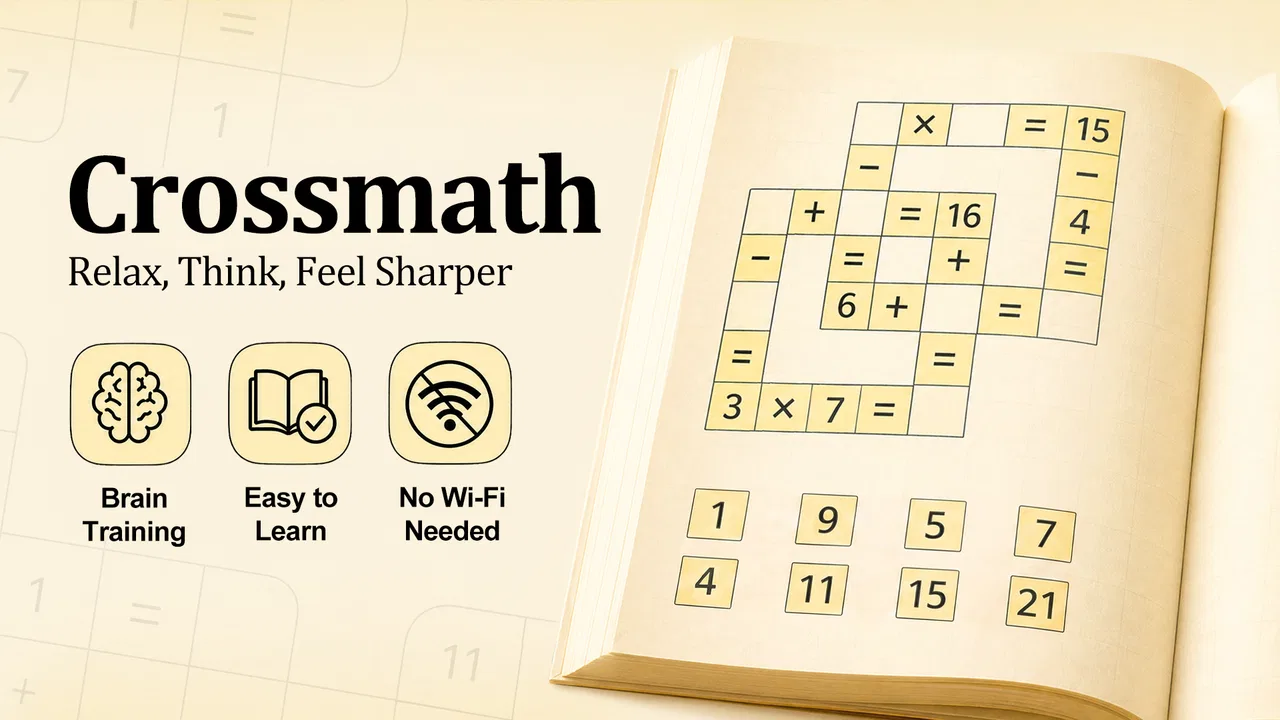
The central idea is straightforward: solve arithmetic equations and place the answers so that the intersecting rows and columns remain correct. That small change from ordinary number questions matters. I am not simply calculating one expression at a time; I am also checking how a possible answer affects the rest of the board. A result that looks right in isolation may be wrong for the grid, which creates the satisfying deduction element that separates this from a basic arithmetic worksheet.
You May Also Like

 Blood Strike: 2.5 Anniversary
Blood Strike’s Loadouts Turn Every Drop Into a Tactical Gamble
A close look at Blood Strike’s custom loadouts: how fast access to signature weapons reshapes its battle royale rhythm, rewards preparation, and narrows the gap between fights.

 Pandora - Music & Podcasts
Pandora’s Music Is Easy to Start, but Harder to Recover
Pandora’s strength is its low-effort path from a seed to a station. Its weak spot is how much confidence it asks you to place in connection, setup, and quiet recovery.

 8 Ball Pool
 Is Built on Rivalries, Rematches, and Routine
A close look at the rivalries, rematches, shared routines, and unanswered safety questions that turn a quick pool match into a persistent mobile community.

 Samsung Music
’s Quiet Strength Is Playing What You Already Own
Its reach comes less from spectacle than from dependable access to a personal library. That simplicity is both the app’s strongest retention engine and its ceiling.

 AccuWeather: Weather Radar
AccuWeather Review: A Quick, Clear Forecast for Everyday Decisions
For everyday plans, the best forecast is the one you can understand quickly. AccuWeather makes rain timing, radar, and local conditions easy to act on, with a few trade-offs.

 Hill Climb Racing
Why Hill Climb Racing Still Turns Crashes Into One More Run
A tiny car, a bumpy hill and one more upgrade: Hill Climb Racing keeps resurfacing because its simple chaos makes every near-miss feel personal.
More From Our News Desk



I found the opening moments easy to understand. The game does not require a long explanation before I can begin, and the familiar symbols make the objective clear. The challenge comes gradually from deciding which equation to solve first, which values are constrained by nearby entries, and when to leave an uncertain space alone. That makes it accessible to casual players while still giving experienced puzzle fans something to think about.
A useful way to approach a board is to start with the equations that have the fewest possible answers. If a row contains a nearly complete calculation, it gives me a reliable anchor. I then use that result to narrow the possibilities crossing it. This is more efficient than jumping randomly around the grid, and it reduces the temptation to guess. When I get stuck, I look for a crossing that can eliminate several options rather than repeatedly recalculating the same expression.
That workflow is one of the game’s quiet strengths. It rewards careful observation as much as fast mental arithmetic. Someone who is not especially quick with numbers can still make progress by using the structure of the board. Conversely, a player who calculates rapidly may still make mistakes by overlooking how an answer interacts with a neighboring equation. The best sessions feel like a blend of arithmetic, pattern recognition, and cautious planning.
Why it works well for short breaks
I can imagine using this during a coffee break, while waiting for an appointment, or at the end of the day when I want something more active than scrolling. A typical session does not need the emotional investment of a role-playing game, and there is no story to remember after putting it down. I can play one puzzle, stop, and return later without wondering what I was supposed to be doing.
That makes it particularly suitable for people who want a quiet mental reset. The game asks enough from me to interrupt distracted thinking, but the rules are simple enough that I do not feel burdened by learning a complicated system. It can also suit parents looking for a screen activity centered on arithmetic rather than reflexes, although the experience is most enjoyable when the player treats it as a puzzle instead of a forced lesson.
The relaxing quality has a limit, though. A difficult board can become tense when I have filled several spaces and discover that one early assumption was wrong. That tension is not a flaw by itself; it is part of the deduction. Still, anyone seeking a completely soothing game may prefer a gentler matching or coloring title. Crossmath asks me to stay mentally present, even when the interface feels calm.
What makes the difficulty more interesting than ordinary math drills
Traditional arithmetic practice usually asks for a single answer and moves on. Here, the answer has a second job: it must fit the crossing structure. That creates useful ambiguity. If two calculations appear plausible, the surrounding entries help determine which one belongs in the space. I often found myself postponing a difficult equation and solving an easier crossing first, then returning with better information.
This is also where the game can support different skill levels. A player who needs more time can work methodically, writing down possibilities mentally and checking each intersection. A confident player can try to solve several equations at once and use the grid as a verification tool. The same board therefore offers more than one route to completion, which is more engaging than a fixed sequence of isolated questions.
One practical tip is to separate calculation errors from placement errors. When a board stops making sense, I first recheck the arithmetic, then inspect whether a correct result was placed in the wrong crossing. Mixing those two checks can make a small mistake feel much larger. I also avoid committing to a value simply because it makes one row work; the crossing equations are the final test.
Where the experience can lose momentum
The main weakness is repetition. The core pleasure comes from the same loop every time: calculate, place, cross-check, and correct. That loop is satisfying for a while, but it does not provide the variety of a puzzle game built around different mechanics, visual themes, or narrative chapters. If I play for too long in one sitting, the mental rhythm can start to feel predictable.
This matters most for players who need constant novelty. Someone who enjoys word puzzles may appreciate the crossword-like layout but miss the richer vocabulary and clues of a conventional crossword. Someone who prefers Sudoku may find the arithmetic element more demanding but the logic less pure. And someone who wants action, social play, or a strong sense of progression should probably choose a different type of game rather than expecting this one to become something it is not.
The free entry point is helpful, but in-app purchases range from $0.99 to $10.99 per item. That does not prevent me from trying the game without paying, yet it is worth remembering if I am evaluating it for a child or for someone who prefers a completely purchase-free experience. I would recommend checking the device’s purchase controls before handing it over, especially in a family setting. The game’s basic appeal is easy to understand without spending money, but the presence of optional purchases may still matter to some users.
Another consideration is arithmetic comfort. The Everyone age rating describes the suitability of the presentation, not the difficulty of the calculations. A child may understand the rules but still find the equations frustrating if multiplication, division, or order of operations are not familiar. I would introduce it as a shared puzzle for younger players rather than assume it will work as independent play from the beginning. Solving one or two boards together can show whether the challenge feels motivating or discouraging.
Small habits that improve the solving experience
I get better results when I treat the board as a network rather than a list of questions. First, I scan for equations with obvious outcomes. Next, I use those answers to examine the crossings with the most restrictions. Finally, I return to the ambiguous spaces only after the grid has supplied more clues. This approach reduces random trial and error and makes the game feel more like deduction than mental calculation.
It also helps to pause before changing several entries at once. If I alter multiple guesses together, I lose track of which decision caused the conflict. Correcting one uncertain position at a time preserves the reasoning chain. This is a small habit, but it turns a frustrating board into a manageable investigation and makes the game more useful for anyone trying to improve concentration.
For a family session, I would let one person calculate while another explains why the answer must fit a particular crossing. That changes the activity from silent practice into collaborative reasoning. It is especially useful when a player knows the arithmetic but rushes the placement. The conversation exposes the difference between “this equation equals that number” and “this number belongs here,” which is the central idea of the game.
For personal use, I would avoid treating every completed board as a test of speed. The strongest part of the design is accuracy under constraints, not racing through familiar operations. Taking a few extra seconds to verify a crossing usually saves more time than repairing a chain of guesses. Players who enjoy measurable improvement may naturally become faster, but the game remains worthwhile even when played slowly.
How it compares with other puzzle choices
Compared with a standard calculator-style math app, this offers more context and decision-making. A calculator can confirm an answer, but it does not ask me to decide where that answer belongs or use it to unlock another part of a grid. Compared with Sudoku, Crossmath places more emphasis on computation and less on purely numerical placement logic. Compared with a crossword, it replaces language clues with equations, making it a better fit for players who enjoy numbers more than wordplay.
Those comparisons also clarify when another option is better. I would choose Sudoku for a longer, quieter logic session with no arithmetic burden. I would choose a crossword when I want vocabulary and clues to drive the experience. I would choose a fast arcade puzzle when I want reflexes and visual energy. Crossmath is strongest in the middle: it is a focused logic game with enough calculation to keep the brain engaged, but without the complexity or pressure of many larger puzzle titles.
The current version is 4.8.0, and the game supports devices running Android 6.0 or later. That makes it practical for people who keep an older compatible phone or tablet rather than upgrading solely for a casual puzzle. On iOS or Android, the important question is less about hardware power and more about whether the player enjoys the format. This is not a game I would recommend because of flashy technology; I would recommend it because the basic interaction is clear and dependable.
Who should download it, and who should pass
I think it is a good match for adults who want a compact mental workout, students reviewing arithmetic in a less formal setting, and families looking for a shared number puzzle. It also suits people who like crossword layouts but want something with more concrete rules than word clues. The free price makes it easy to sample, and the broad age rating means it can fit into many households, provided the level of arithmetic feels appropriate.
I would be more cautious about recommending it to players who dislike repetition, feel anxious around math, or want a strong narrative reason to keep playing. It is also not my first choice for someone seeking multiplayer interaction or a competitive leaderboard-driven experience. The game’s appeal depends on enjoying the board itself, not on expecting a large collection of unrelated activities.
For someone unsure, my advice is to play slowly at first and notice what kind of mistake feels more interesting: getting the calculation wrong or placing a correct result incorrectly. If the second problem sounds satisfying, the crossmath format is probably a good fit. If even the first few boards feel like homework, another puzzle category will likely provide more enjoyment.
My final take
Crossmath® - Math Puzzle Games succeeds because it gives basic arithmetic a meaningful structure. I am not merely answering questions; I am building a consistent grid, using each solution to test the next decision. That design makes it more thoughtful than a simple drill and more approachable than many logic games that require a long tutorial.
It is not endlessly varied, and the optional purchases are a point to keep in mind, but those limitations do not undermine the central experience. Guru Puzzle Game has created a focused title that is easy to pick up, useful for short sessions, and capable of making familiar calculations feel like genuine deduction. With more than 10 million installs, it has clearly found an audience, and I can understand why.
My recommendation is clear: choose it if you want calm, number-based reasoning in compact sessions, and skip it if you need story, social competition, or constant mechanical variety. For me, it works best as a daily mental pause—long enough to sharpen attention, short enough to fit into ordinary life, and simple enough that I can return to it without relearning anything.
FAQs for Crossmath® - Math Puzzle Games
01What is Crossmath® - Math Puzzle Games?
Crossmath® - Math Puzzle Games is a challenging and engaging app designed to improve your mathematical skills through a series of puzzle games. It combines elements of Sudoku and traditional math problems, offering a unique way to test and enhance your arithmetic abilities. The puzzles are designed for all age groups, making it both educational and fun.
02How does the gameplay work in Crossmath®?
In Crossmath®, players solve puzzles by filling in missing numbers on a grid. The objective is to make each row and column equal a specific sum, similar to Sudoku but with arithmetic operations. The game increases in difficulty as you progress, providing a continuous challenge that helps to sharpen your math skills.
03Is Crossmath® suitable for all ages?
Yes, Crossmath® is designed to be suitable for players of all ages. The game features varying levels of difficulty to cater to different skill levels, from beginners to advanced math enthusiasts. It's an excellent tool for children to practice math skills and for adults to keep their minds sharp.
04Does Crossmath® offer in-app purchases?
Crossmath® offers a range of in-app purchases that provide additional features and content. While the base game is free to download and play, users can purchase hints, remove ads, or unlock premium puzzles to enhance their gaming experience. However, these purchases are optional and not necessary to enjoy the game.
05Is an internet connection required to play Crossmath®?
Crossmath® can be played offline, making it a convenient option for enjoying puzzles anytime and anywhere. However, an internet connection is needed for initial download, updates, and accessing certain features like in-app purchases or leaderboard competitions. This offline capability ensures uninterrupted play even without internet access.
Pros
- Engaging puzzles boost cognitive skills.
- Varied difficulty levels for all ages.
- Intuitive user interface enhances experience.
- Regular updates keep content fresh.
- No intrusive ads for a seamless play.
Cons
- Limited hints can frustrate beginners.
- Occasional lag on older devices.
- In-app purchases can be pricey.
- Requires internet for some features.
- No multiplayer mode available.

Crossmath® - Math Puzzle Games
Gallery